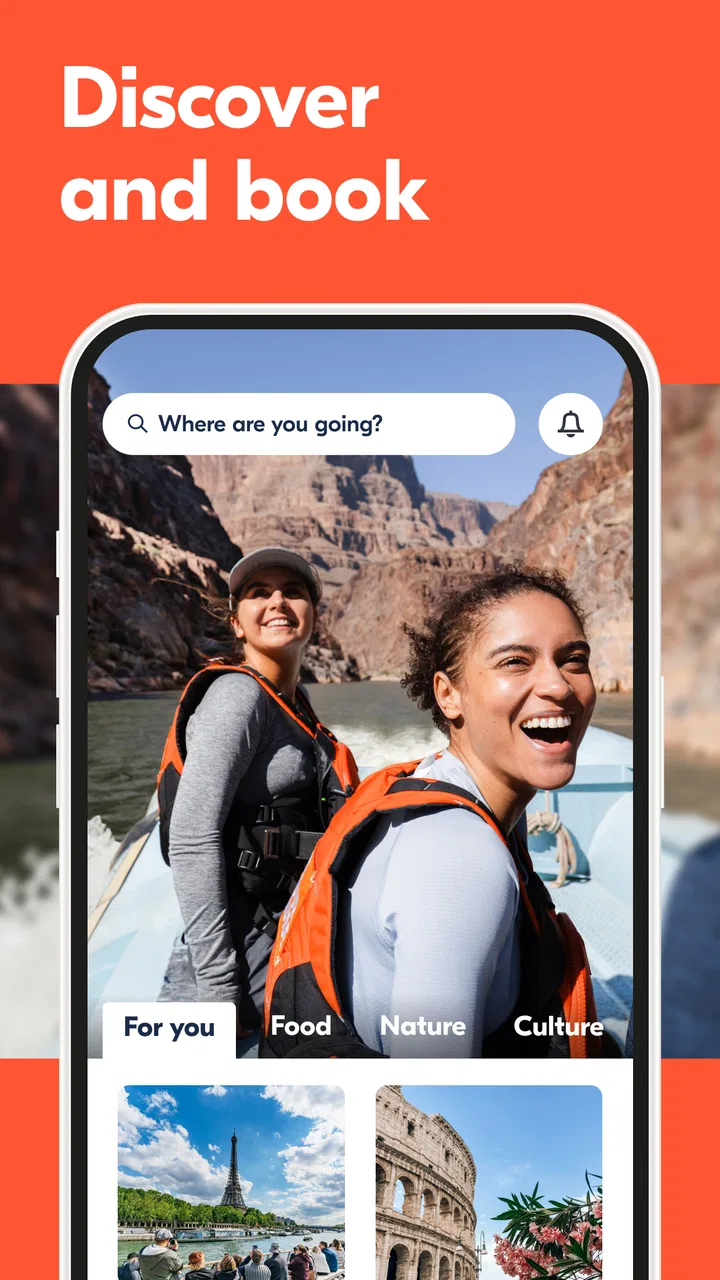
GetYourGuide: Travel & Tickets
- 4.9
- Rating
- 10.00M
- Installs
- Free
- Price

 Analysis by App-foxy
I like travel apps that solve a real problem rather than simply collecting places in a digital scrapbook. GetYourGuide: Travel & Tickets is useful because it focuses on the moment when a trip moves from planning to doing: finding something available, understanding what it involves, and booking it without jumping between several websites. My overall view is positive, but with an important qualification. It is strongest when I want a convenient way to compare organized activities, tours, tickets, and local experiences. It is less convincing when I already know exactly what I want, prefer to arrange everything directly, or need the most local and flexible option.
Developed by GetYourGuide, this free Travel & Local app is aimed at people who want to discover and book things to do while traveling. It has built a substantial audience, with over ten million installs and an average rating of 4.8 from around 279 thousand ratings. Those figures do not make every listing perfect, but they do suggest that the app has become a familiar part of many travelers’ planning routines. I found its main appeal less about browsing endlessly and more about reducing the effort between “that sounds interesting” and “I know how to reserve it.”
How GetYourGuide works when I am planning a real day out
The app makes the most sense when I begin with a destination and a loose idea rather than a fully formed itinerary. I can look for sightseeing, attraction tickets, guided tours, food-related activities, day trips, and other bookable experiences in the place I am visiting. That range is valuable because it lets me compare different ways of spending the same afternoon: a structured tour, a simple entry ticket, or an activity that gives me more interaction with a local area.
You May Also Like

 AccuWeather: Weather Radar
AccuWeather Review: A Quick, Clear Forecast for Everyday Decisions
For everyday plans, the best forecast is the one you can understand quickly. AccuWeather makes rain timing, radar, and local conditions easy to act on, with a few trade-offs.

 Hill Climb Racing
Why Hill Climb Racing Still Turns Crashes Into One More Run
A tiny car, a bumpy hill and one more upgrade: Hill Climb Racing keeps resurfacing because its simple chaos makes every near-miss feel personal.

 AliExpress - Shopping App
AliExpress Makes Global Shopping Feel Personal, but Shoppers Bear the Risk
AliExpress turns a global marketplace into a pocket-sized discovery engine. Its reach is useful, its shopping loop compelling, and its trade-offs easy to miss.

 Lords Mobile: Kingdom Wars
Lords Mobile Is a Kingdom-Building Routine, Not a Quick Match
A case-by-case verdict on the building, battles, device demands, and social commitments that make Lords Mobile rewarding for some players and exhausting for others.

 PDF Scanner app - TapScanner
TapScanner Makes Paperwork Easier to Capture, Check, and Share
TapScanner makes scanning with a phone feel less like a rescue operation and more like a dependable step in getting work done. Its capture tools are useful, though not flawless.

 Block Blast!
 Shows How Much a Puzzle Game Can Leave Out
A quiet grid game shows why puzzle players increasingly value instant clarity, repeatable skill and low-pressure play—and where the genre still needs to catch up.
More From Our News Desk
View All News


What I appreciate is the way the app turns a broad travel question into a shortlist. Instead of searching separately for an attraction, its opening hours, a suitable tour, and a reservation process, I can inspect several possibilities in one place. The useful habit is to begin with the date and the amount of time I actually have. A highly rated outing that takes most of a day is not a good choice if I only have a free morning, and an inexpensive-looking ticket may be poor value if reaching the meeting point takes too long.
The listing itself deserves careful reading. I do not treat the title or photographs as enough information. I look at what is included, where the activity begins, how long it lasts, whether transport is part of the arrangement, and what kind of experience the description promises. This is one of the app’s strengths: it gives me a central place to make those comparisons. It is also where the user needs to stay alert, because two activities that appear similar in search results can have very different meeting arrangements or levels of guidance.
A practical workflow is to save a small group of candidates before booking anything. I compare the start time against my other plans, check whether the activity leaves enough room for delays, and then read the cancellation terms shown for that particular listing. I would not assume that every experience follows the same rules. The app is a marketplace for many activities, so the conditions belong to the individual booking rather than to a single universal format.
That marketplace structure is both the reason the app is useful and the reason it requires judgment. The app can help me discover options quickly, but the experience itself is delivered by the provider attached to the booking. In other words, a polished interface cannot remove the need to inspect the details of the tour or ticket I am choosing. I see GetYourGuide as a strong organizer of choices, not as a guarantee that every activity will suit every traveler.
The details that matter more than the headline
One of the less obvious advantages is how useful the app can be for filling gaps in an itinerary. I may already have flights and accommodation arranged, yet still have an unplanned evening or a free day. Searching by destination and date gives me a faster starting point than trying to invent an activity from scratch. This is especially helpful in an unfamiliar city, where I may not know which attractions require advance planning.
I also use it as a comparison tool before committing. Even if I later decide to buy directly from an attraction or operator, browsing the available formats helps me understand what kinds of experiences exist. A basic admission ticket may suit an independent visitor, while a guided option could be better for a first visit when context and logistics matter more than wandering alone. That distinction is more useful than simply choosing the listing with the most attractive image.
Another practical insight is to treat timing as part of the price, even when the app does not present it as a separate cost. A tour that starts far from my hotel may require a long transfer and an early departure. A ticket with a fixed entry window may be less convenient than a slightly different option that fits naturally between meals or transport connections. I find the app most effective when I use it to protect my time, not just to find a low-cost activity.
For a family, the age information and activity description deserve particular attention. The app carries an Everyone content rating, which describes the app’s general suitability rather than guaranteeing that every listed experience is appropriate for every child. I would still check the individual activity’s requirements, walking distance, duration, and meeting instructions. A family may appreciate the convenience of booking in one place, but a long walking tour or a late return can be a poor match even if the app itself is easy for everyone to use.
For solo travelers, the app can reduce a different kind of friction. I do not need to spend an evening deciding whether a local activity is legitimate enough to investigate, then searching for a separate reservation process. A clear listing and a defined meeting point can make an unfamiliar plan feel more manageable. Still, I would choose activities with realistic schedules and straightforward arrival instructions rather than overloading a day with several fixed commitments.
Where the booking experience is genuinely convenient
The clearest benefit is concentration. Search, discovery, and booking sit together, which is much easier than keeping multiple browser tabs open while comparing providers. This matters most when I am traveling with someone else and need to make a decision quickly. I can show a few alternatives, compare their practical differences, and settle on one without rebuilding the search from the beginning.
The app is also useful for spontaneous planning, though I would define “spontaneous” carefully. I might decide in the morning that I want to do something that afternoon, and the app can reveal what is available for that window. Availability is not the same as suitability, however. I still check the start location, duration, and booking conditions before assuming that a last-minute choice will fit.
For a traveler who dislikes negotiating with unfamiliar websites, this simplicity has real value. The app feels like a single travel drawer containing many possible activities. That does not necessarily produce the cheapest or most authentic choice every time, but it can save the mental energy that often disappears into logistics. When I am already managing transport, accommodation, and changing plans, that reduction in administrative work is meaningful.
The app is free to install, which makes it easy to use as a planning companion even before I decide to book. It runs on operating systems starting with version 10, and its current version is 26.10.0. The product has been available since October 9, 2013, so it is not a new experiment in the travel category. I see that maturity in the general purpose of the app: it is designed around repeated travel decisions rather than one narrow attraction or one city.
The weakness: convenience can hide important trade-offs
My main reservation is that a large marketplace can make comparison look simpler than it really is. Search results may place different types of experiences next to one another, but the differences can be significant. A ticket, a guided visit, and a transport-inclusive excursion are not interchangeable, even if their names point to the same landmark. I have to read beyond the first screen to understand what I am actually buying.
There is also a risk of choosing based on presentation. Strong photography and a persuasive description can make an activity feel more appealing than its schedule or logistics justify. I recommend checking the meeting point on a map, allowing extra time for arrival, and reading recent comments for practical clues rather than relying only on the average rating. A high overall score is encouraging, but it cannot tell me whether the pace suits my group or whether the activity matches my expectations.
Another limitation is that the app is not automatically the best route for every booking. If I am buying a simple museum entry, the attraction’s own service may offer a more direct relationship and clearer information. If I want a very independent day, public transport and self-guided research may give me more control. If I care deeply about supporting a particular small operator, I may prefer to contact that provider directly after discovering it elsewhere.
I would also avoid treating a booking platform as a substitute for checking local realities. Weather, transport disruptions, temporary closures, and changes at a venue can affect an otherwise well-organized plan. GetYourGuide can help me reserve an activity, but I still need to keep the booking information accessible and verify the practical details before setting out. The app reduces uncertainty; it does not eliminate it.
For travelers who dislike fixed schedules, the trade-off is even clearer. Many organized experiences require me to arrive at a particular time and follow a planned route. That structure is a benefit for someone who wants guidance, but a constraint for someone who prefers to stop whenever a street, café, or viewpoint catches their attention. I would skip the app as my main planning tool if my ideal trip is deliberately unstructured and booking-free.
A realistic use case: rescuing an unplanned afternoon
Imagine I am visiting a city for several days and discover that rain has changed my outdoor plans. I open the app, search activities for that day, and narrow the choices by time rather than choosing the first attractive result. I compare an indoor attraction ticket with a guided option, then check how long each takes and where I need to go. The best decision may not be the most popular activity; it may be the one that starts near my current location and finishes before dinner.
Before confirming, I read the inclusions and cancellation information, check the meeting instructions, and make sure the reservation does not create a risky connection with my next plan. That process is where the app earns its place. It gives me a manageable set of alternatives when I have limited time and imperfect information. Without those checks, the same convenience could lead me into an activity that looks ideal but is impractical in the real itinerary.
For a family in the same situation, I would add a check for walking demands and the children’s ability to stay engaged for the full duration. For a solo traveler, I would prioritize a clear arrival point and a schedule that leaves room to navigate. For a couple, I might compare whether a private-feeling activity is worth the extra structure of a group tour. The app provides the options, but the quality of the result depends on matching the format to the people traveling.
Who should use it, and who should look elsewhere
I recommend GetYourGuide most strongly to travelers who want organized discovery without spending hours researching every provider separately. It suits first-time visitors, people planning short city breaks, families that value advance arrangements, and anyone who wants to turn a free afternoon into a concrete plan. It is particularly helpful when I know the destination but do not yet know which experiences are practical or worth reserving.
It is also a good fit for travelers who want a safety net of information around a booking. Seeing the activity description, schedule, and meeting instructions together can feel more reassuring than finding a vague recommendation in a social post and then trying to arrange it independently. The app’s free access makes it reasonable to browse even if I am still deciding how much structure I want.
I would be more cautious if price is my only concern. A marketplace may be convenient, but convenience is not the same as the lowest possible total. I would compare a shortlisted activity with the official attraction or operator when the booking is simple and the difference matters. I would also avoid booking through it merely because an activity has a strong rating; the format, timing, and conditions need to fit my trip.
Independent travelers who enjoy building their own routes may prefer maps, official venue information, and direct reservations. That approach can offer more flexibility and sometimes a clearer connection with the place itself. GetYourGuide is better when I want a curated starting point and an easier booking workflow than when I want to remove all intermediaries.
My verdict after weighing the convenience against the compromises
My recommendation is clear: use GetYourGuide as a practical activity finder and booking hub, not as the sole authority for every travel decision. Its strongest quality is the way it turns vague free time into comparable, reservable possibilities. The app is easy to justify for a short trip, an unfamiliar destination, or a day when I need a plan quickly. Its broad audience and 4.8 average rating reinforce that it works well for many people, while the ten-million-plus install mark shows how established it has become.
At the same time, I would never book on autopilot. I read the complete activity details, compare the schedule with my real itinerary, inspect the meeting point, and check the conditions attached to that specific experience. Those steps are not unnecessary caution; they are what make the marketplace useful. The app can save research time, but it cannot decide whether a particular tour is worth losing half a day or whether a direct booking would be better.
As a free app for Everyone, it is accessible to a wide range of travelers, and the mature product from GetYourGuide is polished enough to become part of my normal trip-planning routine. I would open it when I need ideas, when plans change, or when I want to compare organized experiences in one place. I would look elsewhere when I already have a trusted local contact, need maximum flexibility, or am dealing with a straightforward ticket where the official source is the more natural choice.
In short, I see it as a strong middle ground between random travel searching and a completely self-planned itinerary. GetYourGuide: Travel & Tickets is at its best when convenience, discovery, and a bookable plan matter more than absolute independence. Used with a few minutes of careful reading, it can make a trip easier to shape without pretending that every listed experience is automatically the right one.
FAQs for GetYourGuide: Travel & Tickets
01What is GetYourGuide and how does it work?
GetYourGuide is a travel app designed to help users discover and book unforgettable experiences around the world. From guided tours to museum tickets, the app offers a wide range of activities. Simply search for your destination, browse available activities, and book directly through the app for a seamless experience.
02Is GetYourGuide available worldwide?
Yes, GetYourGuide features activities and experiences in thousands of cities across the globe. Whether you're planning a trip to a major city or a remote location, you're likely to find options. The app regularly updates its listings, ensuring a diverse selection no matter where you are.
03Are there any fees associated with using GetYourGuide?
Downloading and using the GetYourGuide app is free. However, the activities and experiences you book through the app will have their respective prices. Occasionally, there might be fees related to certain payment methods or currency conversions, so it's advisable to review all costs before booking.
04What types of activities can I book through GetYourGuide?
GetYourGuide offers a vast array of activities including guided tours, cooking classes, museum tickets, adventure sports, and more. Whether you're interested in cultural experiences, outdoor adventures, or unique local activities, the app provides numerous options to fit various interests and budgets.
05How reliable are the reviews and ratings on GetYourGuide?
GetYourGuide aggregates reviews and ratings from verified users who have previously booked and experienced the activities. This ensures authenticity and helps maintain high standards. Users can read detailed reviews and see ratings to make informed decisions when selecting activities.
Pros
- User-friendly interface enhances navigation.
- Wide range of activities to choose from.
- Easy booking process saves time.
- Real-time availability updates are helpful.
- Customer reviews aid in decision-making.
Cons
- Some activities can be pricey.
- Limited last-minute booking options.
- Occasional app crashes reported.
- Not all attractions available globally.
- Offline mode is not fully supported.

GetYourGuide: Travel & Tickets
Gallery